Creating a digital cartographic basemap on the territory of the Russian Federation
Creating a digital cartographic basemap on the territory of the Russian Federation
01
About the project
Creating a digital cartographic background on the territory of the Russian Federation, working out and adding attribute information to vector layers
Industry
Mapping
Customer
ROSATOM State Corporation
End date
11/30/2019
02
Project goal
Creating a digital cartographic background on the territory of the Russian Federation, working out and adding attribute information to vector layers
03
Completed works
1. As a result of the service, a digital cartographic background for the regions of the Russian Federation was created. The substrate was designed in a GIS project in the Esri ArcGIS 10.5 format. The data is provided in the Esri shapefile format in the WGS 84 projection.
Composition of the digital map substrate:
Regional borders and administrative divisions of the Russian Federation – polygonal type of geometry;
Localities with a population of 500 or more – point geometry type;
Objects of the mining and manufacturing industry with an annual revenue of 500 million rubles per year – point type of geometry;
Energy objects (electrical generation) - point type of geometry;
Road network – linear type of geometry;
Railway network – linear type of geometry.
2. Description of the content of the layers
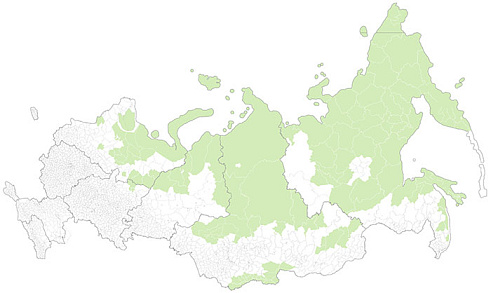
Regional borders and administrative divisions of the Russian Federation are represented in 4 layers – Russia, Federal Districts, Regions, and municipalities. Layer attributes: Geometry type, Name, Administrative Division level, OKTMO code (for regions and municipalities).
Localities with a population of 500 or more were represented in 154 layers, with 1 layer for each municipality. Layer attributes: Geometry Type, Name, Population, OCTMO Code. The population for cities and urban-type settlements is relevant for 2018, for villages for 2014.
Mining and manufacturing facilities with an annual revenue of 500 million rubles per year were presented in 154 layers, with 1 layer for each municipality. Layer attributes: Geometry type, Activity type, Revenue in millions of rubles. Revenue up-to-date from 2013 to 2018
Energy facilities (electric generation) were presented in 154 layers, with 1 layer for each municipality. Layer attributes: Geometry type, Name, Type, Installed capacity in MW. The installed electric capacity is relevant no later than 5 years, mainly for 2018.
The road network was presented in 154 layers, with 1 layer for each municipality. Layer attributes: Geometry type, Road level. This layer contains highways up to and including Class IV.
The railway network was represented in 154 layers, with 1 layer for each municipality. Layer Attributes: Geometry type
Fig. 1 Workflow chart
Схема-выполнения-работ-Росатом.jpg
04
Result
As a result of the service, a digital cartographic basemap for the regions of the Russian Federation was created, which is designed in a GIS project in the Esri ArcGIS 10.5 format.
Need satellite imagery or help choosing the right data?
Describe your task, area of interest, and desired outcome. We will check data
availability, assess new acquisition options, and propose the optimal solution in terms of timelines, cost,
and quality.
Fast feedback during business hours
We will select the best data for your task
Confidentiality guaranteed
Discuss the project
clients who trust us
25+ years in the geodata market
Мы используем Яндекс.Метрика и собственные Сookies для обеспечения наилучшего
опыта работы на нашем сайте, персонализации сайта для наших пользователей и аналитики.
Продолжая использовать сайт вы соглашаетесь с условиями
Пользовательского соглашения.
Request a call
Leave your contact details — we will get back to you during business hours, clarify the task and suggest suitable data or services.
Write to e-mail
Send a message, technical specification or task description. We will review your request and reply to the specified e-mail.
Fill in the order form
Describe the area, object and imagery requirements. We will check archive availability, the possibility of a new acquisition and offer a suitable option.
Order software
Order TK
Your application is accepted
We will contact you during working hours.
Выбрать город
Россия
Другие страны
Белоруссия
Contact via WeChat
Feliks Fokin
Open WeChat and scan the QR code to add the contact. On a phone, save the code and select it in the WeChat scanner.