LULC maps, 3D cadastre schemes and monitoring of cities and land degradation — from an archive or a new survey.
Search the site
What the service is used for
Landscape plans
Development of landscape plans and topographic-geodetic bases.
Functional zones
Identification of residential, industrial and public zones in settlements.
Urban planning
Territory development schemes and assessment of land suitability for construction.
LULC and degradation
Monitoring of land degradation, cities, forest cover and land-use change.
3D cadastre
Three-dimensional land administration systems and models of the built environment.
Need RS data for land use?
Describe the territory and the task. A specialist will select the archive, a new survey and the set of maps.
What you will receive as a result of the work
01
LULC and land-cover maps
Classification of land cover and land use, assessment of forest-cover change rates and landscape dynamics.
Land-use and land-cover change (LULC) is a component of environmental monitoring and natural-resource management. We combine Earth observation data and field cadastres, classify land cover and record its changes over selected periods.
What you get
- thematic LULC maps for selected dates
- assessment of forest loss and its links with agriculture, savannas and urbanisation
- materials in the agreed raster and vector format
The class set, survey dates and coverage depend on the archive, cloud cover and the terms of reference.
02
Urban planning and functional zones
Identification of residential, industrial and public zones, territory development schemes and assessment of land suitability for development.
Information on urban land use is needed for planning and sustainable development. From RS data and additional geospatial sources we extract residential, industrial and public zones, assess territory use and its suitability for development.
What you get
- functional-zone schemes of settlements
- assessment of territory suitability for urban planning
- a basis for recording sustainable urbanisation from RS analytics
The detail of the zones depends on survey resolution, the availability of POI and the requirements of the terms of reference.
03
3D cadastre and city model
We create a three-dimensional representation of the land surface and the built environment for 3D cadastre, urban-planning analysis and real-estate management.
The 3D cadastre is linked to urban development and the inner landscape setting. The model is used for city-wide applications or for an individual building.
What you get
- a three-dimensional model of the surface and built-up area
- a basis for 3D cadastre and building applications
- an agreed model format per the ToR
Model accuracy depends on the survey, ground control points and the composition of the source data.
04
Land degradation, forests and reclamation
Monitoring of desertification, land degradation, forest-cover dynamics and water reclamation.
Forest-cover losses are linked to agriculture, savannas and urbanisation; carbon stocks under forest degradation contribute to greenhouse-gas emissions (CO2, CH4, N2O, O3 and others). From multi-date RS data we detect land degradation and desertification, forest-cover change, the condition of reclaimed territories and risks of salinisation or waterlogging.
What you get
- maps of degradation, desertification and forest-cover change
- reclamation layers and related risks to land quality
- analytical data for assessing the condition and changes of the territory
The change-detection threshold depends on survey resolution and the length of the date series.
05
Cadastre, utilities and construction
Cadastral surveys, property inventory, analysis of utility routes and assessment of territory suitability for construction or extraction.
Imagery makes it possible to determine territory boundaries and inventory property; very high resolution — to inventory small objects. RS helps select a routing option for a gas or oil pipeline across private land, nature-protection zones and nature reserves. Regular monitoring controls construction and field development. From imagery, zones of potential hazard and sanitary protection zones at plants, gas and oil pipelines, and gas, oil and fuel storage facilities are extracted.
What you get
- boundaries and object inventory from aerospace images
- analysis of territories for utility routes
- a geoinformation basis for design and construction control
The scope of work depends on the scale, survey resolution and cadastre or project requirements.
How the work goes
Real projects — real results
We solve complex challenges using advanced technologies and expertise in geospatial data.


Cost and timeline
The cost and timeline of land-use work depend on the area, archive or new survey and the set of LULC and cadastre maps.
- task: landscape plans and topographic bases, functional zones, territory development schemes, land degradation, LULC, 3D cadastre, land reclamation, cadastral survey
- data type: satellite, aerial survey, UAV; optics and LiDAR; archive or new survey; if needed — combination with field cadastres
The cost of the work is calculated individually
Timelines depend on the area, survey type and product composition
We will agree the final estimate after the territory and the map set are described
What is needed for a quote
To agree the terms of reference for land use and land resource management, provide:
- task: landscape plans, functional zones, urban planning, land degradation, LULC, 3D cadastre, land reclamation, cadastre or utility monitoring
- area of interest — outline of a plot, municipality, city, forest massif or SHP file
- period: operational control, several dates for cover dynamics or a retrospective
- whether you have your own images or cadastres or need archival / new satellite imagery, aerial photography, UAV or LiDAR
- whether LULC maps, zoning schemes, a 3D model of the built environment, orthoimagery or a boundary vector are needed
- requirements for scale, coordinate system and layer format, if they are already known
If survey parameters have not been defined yet, send the territory outline and describe the task — we will select an archive or a new survey and propose the set of maps and RS data.
Why Innoter
Prompt access to archives
Suitable archive imagery can be obtained faster when the required area and date are already available from operators.
No aviation clearances
A new satellite survey does not require the flight clearances typical of aerial surveys.
Large and remote areas
A single satellite pass covers large areas and makes it possible to work in hard-to-reach regions.
Direct agreements with operators
Distribution agreements help select archive imagery and order new surveys from different providers.
Software and server infrastructure
Modern software and computing capacity for quality control and processing of large data volumes.
Experienced specialist team
Years of experience on complex projects and specialists in cartography, photogrammetry and remote sensing.
RS data, LULC and monitoring scope
The composition depends on the area, archive or new survey, optics or LiDAR and requirements for maps and cadastre.
1
The 17 Sustainable Development Goals (SDGs) adopted by the United Nations in 2015 are a call to action to eradicate poverty, protect the planet and ensure peace and prosperity by 2030.
Sustainable land resource management is one of the key actions to achieve these goals. Land is a fundamental resource for addressing climate change, conserving biodiversity, maintaining ecosystem services and ensuring prosperity.
Strategies are needed to monitor changes in land use and vegetation cover: productivity, vegetation cover, soil carbon, urban expansion and other indicators. Modern land administration systems include cadastre and land registration as part of the paradigm of land value, tenure, development and use.
Innovative methods of collecting, processing and storing spatial information respond to urbanisation, unstable agricultural development, rural poverty and the increasing complexity of urban infrastructure. Advances in RS and geospatial information provide opportunities for this.
2
Rational use of land resources and territory management require up-to-date information on land condition. Remote sensing makes it possible to develop landscape plans and topographic-geodetic bases; identify functional zones in settlements; create territory development schemes; assess land suitability for urban planning.
Land degradation and urban development are tracked in the logic of sustainable-development tasks. A functional classification system of “production–life–ecology” is built from RS monitoring over several periods. Rates of land- and forest-cover change are quantified; Earth-observation data and field cadastres are combined.
Sustainable urbanisation, land use and vegetation-cover change are recorded. Agricultural landscapes and ecosystem services are mapped. LULC is a component of environmental monitoring. Three-dimensional systems (3D cadastre) are applied in a complex built environment. Water reclamation and related salinisation and waterlogging risks are mapped.
3
Over the last decade UAVs, satellite and airborne data-collection systems and active sensors such as LiDAR have been used more widely. This provides data with high spatial, spectral, radiometric and temporal resolution.
There is progress in automatic image orientation, surface reconstruction, scene analysis, change detection, positioning, classification and feature extraction. Reconstruction, scene analysis and change detection using artificial intelligence, spatial statistics and machine learning are applied to sustainable land-use management.
Open-source geospatial-analysis tools and open RS data make it possible to build LULC monitoring methods and decision-support systems. In timeliness and territorial coverage such approaches exceed field work by several times and approach the high detail of land studies.
4
Task: quantitative assessment of greenhouse-gas emission rates in forest ecosystems — characterisation of land- and forest-cover change.
Solution: combination of Earth-observation data and field cadastres. Land-cover change and forest-cover dynamics in Togo in 1985–2020 from supervised classification of Landsat 5, 7 and 8. Overall classification accuracy for the target years is from 0.91 to 0.98, kappa coefficients from 0.86 to 0.96.
Result: all extracted land-cover classes changed; forest area decreased from 49.9% of the country's territory in 1985 to 23.8% in 2020. Losses are linked to agriculture, savannas and urbanisation. Annual forest-cover change is estimated at −2.11% per year; annual deforestation is 422.15 km² per year, which corresponds to a forest-cover reduction of 0.74% per year over 35 years. Ecological zone IV (mountainous, dense semi-deciduous forests) better retained forest area.
5
Task: assessment of urban land use for planning and sustainable development.
Solution: integration of RS and geospatial big data. Urban land maps by plots from open road-network sources, 10-metre Sentinel-2A images and points of interest (POI). Classification results were checked quantitatively and qualitatively on one test set.
The source materials also include image examples: Astana, KazEOSat-1 © 2016 KGS, Distribution Airbus D; construction of the Rostov Arena stadium for the 2018 FIFA World Cup, GeoEye-1, 14 November 2017, © DigitalGlobe; Olympic facilities of Sochi, Imeretinskaya Lowland, WorldView-2, 10 March 2010, © DigitalGlobe. The illustrations were not transferred into the template gallery.
6
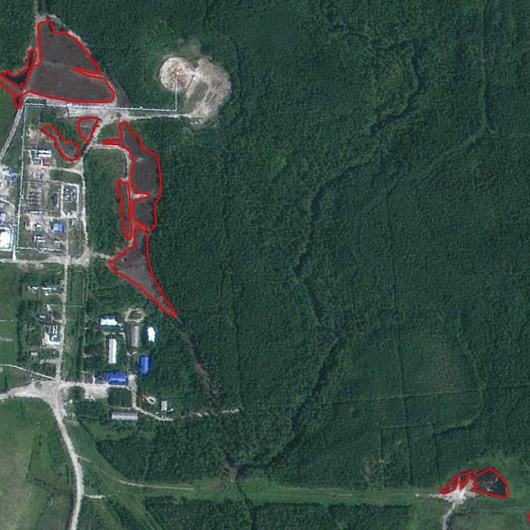
Satellite images are used to extract potential-hazard zones for the population and locations of sanitary-protection zones. High-risk facilities include plants, gas and oil pipelines, and gas, oil and fuel storage. Space monitoring makes it possible to control facility condition almost in real time; high-resolution images provide up-to-date information on condition and dynamics.
Aerospace monitoring methods are applied in cadastral surveys: territory boundaries and property accounting; very high resolution — inventory of small objects, equipment and engineering structures.
When laying trunk utilities, RS helps analyse the crossing of private land, conservation zones and reserves and select a route option. Aerospace survey is needed for large-scale construction, quarry and deposit development: to assess territory suitability, create a GIS for design and control construction stages.

Frequently asked questions
Answers to key questions about service parameters, timelines, deliverable formats and workflow. If you did not find what you need — contact us and we will help.
Land administration is the process of planning, development, utilization and protection of land and natural resources related to land use. It includes coordination and management of various aspects of land use, such as agrarian management, forestry, urban planning, development, nature conservation and environmental sustainability.
Land administration aims at the efficient use of land in accordance with the goals and needs of society, while taking into account environmental, economic and social aspects. It includes the development of land use policies, legislative norms and regulations, as well as mechanisms for controlling and monitoring land use.
The objectives of land management include ensuring food security, preserving biological diversity, preventing negative human impact on natural ecosystems, promoting sustainable development, improving the living conditions of the population and equitable distribution of land rights.
The main tasks of land resources management include planning of land use, administrative regulation of land relations, allocation and distribution of land plots, control over land use, protection of soil and water resources, regulation of land conflicts and dispute resolution.
The main tasks of land resources management include planning of land use, administrative regulation of land relations, allocation and distribution of land plots, control over land use, protection of soil and water resources, regulation of land conflicts and dispute resolution.
Land resources management is carried out by state bodies, local authorities, land experts, public organizations and stakeholders, taking into account the principles of sustainable development and public participation.
Remote sensing land management is the application of modern technology to monitor, analyze and manage land resources. It is an area where resources, rights, sites and governments interact with remotely sensed land technologies for effective land use management.
State and municipal authorities play an important role in land management by utilizing data obtained from remote sensing of land. They can use this information to make decisions on the location of facilities, planning the use of land parcels, controlling compliance with land use rules and regulations, protecting natural resources and protecting the environmental sphere.
Remote sensing of land provides a variety of data about the land, such as information on vegetation, land cover, water levels, and other environmental parameters. These data can be used to determine optimal land use, plan agricultural operations, monitor forest resources, assess ecological status, and monitor changes in the landscape.
Remote sensing of land can also help in establishing legal relations in the sphere of land use. It can be used to determine the boundaries of land plots, establish ownership rights, control land use in accordance with legislation and resolve land disputes.
Russian experience shows that remote sensing of land can be an effective tool in land management. It allows obtaining up-to-date and objective data, reduces monitoring costs and ensures more effective planning and control over land use.
Various types of activities are carried out as part of land management using remote sensing. One of them is monitoring changes in land use. Remote sensing of land can be used to track changes in land cover over time, identifying new development, changes in agriculture or forest cover. This allows the effectiveness of current land use strategies to be assessed and evidence-based decisions to be made.
Another aspect of land management using remote sensing of land is related to planning the use of land parcels. The analysis of remotely sensed data makes it possible to identify suitable land parcels for various purposes such as agriculture, industry, residential areas or protected areas. This helps to optimize the use of land resources, taking into account the requirements and needs of different sectors of the economy and society.
Also, remote sensing of land can be used to monitor compliance with land use rules and regulations. The data obtained from remote sensing can detect illegal changes in land use or violations of environmental norms. This contributes to effective control over the use of land resources, observance of rights and prevention of illegal actions.
State and municipal authorities play an important role in regulating land relations and coordinating land use activities. They monitor and analyze remotely sensed data and make decisions based on the information obtained. In addition, governmental and public organizations can use these data to develop policies and strategies for land management.
Thus, remote sensing of land is a powerful tool in land management. It provides access to a wide range of information on land cover, changes in land use and environmental conditions. This enables informed decisions to be made in the planning, administration and protection of land resources.
Remote sensing of the earth also has a number of advantages. First, it provides the possibility of obtaining data over large areas, including remote and inaccessible areas. This makes it possible to cover vast areas and obtain a comprehensive analysis of land resources.
Secondly, remote sensing of land is a prompt and efficient method of obtaining information. With the help of satellites and other means of observation, periodic measurements and monitoring of the state of the land can be carried out, which allows rapid response to changes and problems.
Third, remotely sensed land data provides objective information based on actual measurements and observations. This helps to avoid subjectivity and human error and provides a more accurate assessment of the condition and utilization of land resources.
Fourth, remote sensing of land is a tool to improve transparency and openness in land management. Access to land cover data and information can be made available to the general public, stakeholders and scientific researchers. This facilitates the participation and involvement of various actors in the land management process.
However, it should be noted that remote sensing of land is only one tool for land management and should be used in conjunction with other methods and data sources. It is also important to take into account contextual and local characteristics, socio-economic factors and community needs when developing land management strategies. Remote sensing of land should be integrated into the broader context of land management, which includes consideration of legal, social, economic and environmental aspects.
An important aspect of land management using remote sensing is the development of skills and competencies in analyzing and interpreting data, and in making decisions based on the information obtained. Training of specialists and exchange of experience between different management bodies and research institutions play an important role in improving the efficiency and quality of land management.
Russian experience in land management using remote sensing of land is considerable. Russian satellites such as Kanopus and Resurs-P are actively used to collect information on the status of land use and monitor changes in land use. This allows for informed decisions on land planning and management at various levels.
In conclusion, land management using remote sensing of land is an effective and promising approach. It contributes to optimizing the use of land resources, controlling their use and protecting the environment. However, it is important to consider a wide range of factors and interests to ensure sustainable and equitable land management in accordance with the needs of society and nature.
Land resource management includes various methods and principles that help effectively utilize and preserve land resources. Below are some of them:
- Land Zoning. Zoning is a fundamental tool for land resource management. It involves dividing land parcels into different zones with specific designations (agricultural, industrial, residential, protected areas, etc.). Zoning enables the rational use of land resources, considering their potential and the needs of different economic and social sectors.
- Land Use Planning. Land use planning involves developing strategies, policies, and programs for land resource management. It is based on data analysis, land potential assessment, and consideration of socio-economic factors and community needs. The goal of land use planning is to optimize land resource utilization, maintain ecological sustainability, and ensure socio-economic development.
- Regulation and Licensing. Government and municipal authorities establish laws, rules, and norms regulating land use. This includes obtaining permits and licenses for land use, monitoring compliance with regulations, and applying sanctions in case of violations. Regulation and licensing help ensure the sustainable and responsible use of land resources.
- Monitoring and Evaluation. Monitoring and evaluating land resource conditions are crucial management components. They provide up-to-date information on land use changes, soil conditions, water quality, and other environmental parameters. Monitoring and evaluation help identify problems, assess strategy effectiveness, and make informed decisions based on factual data. Remote sensing, geographic information systems, and other technologies play a vital role in land resource monitoring and evaluation.
- Public Participation. Public participation is an essential principle in land resource management. It involves engaging stakeholders, such as local residents, non-governmental organizations, and representatives from various economic sectors, in land use decision-making. Public participation promotes transparency, fairness, and legitimacy in land resource management.
- Ecological Sustainability. The principle of ecological sustainability entails preserving and restoring the ecological integrity of land ecosystems. Land resource management should consider the impact of human activities on nature, take measures to prevent soil degradation, water pollution, and biodiversity loss. Ecologically sustainable land management contributes to the long-term preservation of natural land functions and the maintenance of ecosystem services.
- Efficient Land Use. The principle of efficient land use involves maximizing the potential of land to meet social, economic, and environmental needs. It includes optimizing agricultural production, promoting sustainable urban planning, reducing land losses due to erosion and other processes, and rationally utilizing unused land parcels.
- Consideration of Rights and Interests. Land resource management should respect the rights and interests of various population groups, including local communities, indigenous peoples, and small-scale farmers. This includes protecting land rights, ensuring fair land resource distribution, and recognizing traditional land use systems. Considering rights and interests helps ensure fair and sustainable land management, prevent conflicts, and promote social justice.
- Integrated Approach. Land resource management should be carried out using an integrated approach that considers the interconnection of various land use aspects and balances economic, social, and environmental needs. An integrated approach fosters synergy between different policies and activities, ensures sustainable development, and minimizes negative environmental impacts.
- Continuous Learning and Research. Land resource management requires ongoing training and skill development for specialists, as well as scientific research to develop innovative methods and approaches. Education and research contribute to improving land resource management quality, enhancing practices, and enabling evidence-based decision-making.
These methods and principles of land resource management are interconnected and complement each other, ensuring the sustainable and efficient use of land. Their implementation requires collaboration among various stakeholders, effective use of information and technological resources, and consideration of contextual and local specifics in strategy and policy development.

Need satellite imagery or help choosing the right data?
Describe your task, area of interest, and desired outcome. We will check data
availability, assess new acquisition options, and propose the optimal solution in terms of timelines, cost,
and quality.
Discuss the project
clients who trust us
25+ years in the geodata market