
GIS layers of contaminated land and water bodies, sampling points, a register and an analytical report per the ToR.
Search the site
What the service is used for
Licence blocks
Detection of oil spills within licence blocks.
Contamination localisation
Localisation of contaminated land plots.
Reclamation
Assessment of reclamation rates and compliance control for sites after oil spills.
Emergency spill
Detection of emergency oil spills and information support for clean-up.
Inventory
Inventory of land and water bodies, confirmation that reclamation measures have been completed.
Did not find your task?
Send the site coordinates, survey period and questions — we will assess the archive and the scope of work.
What you will receive as monitoring results
01
Contaminated land
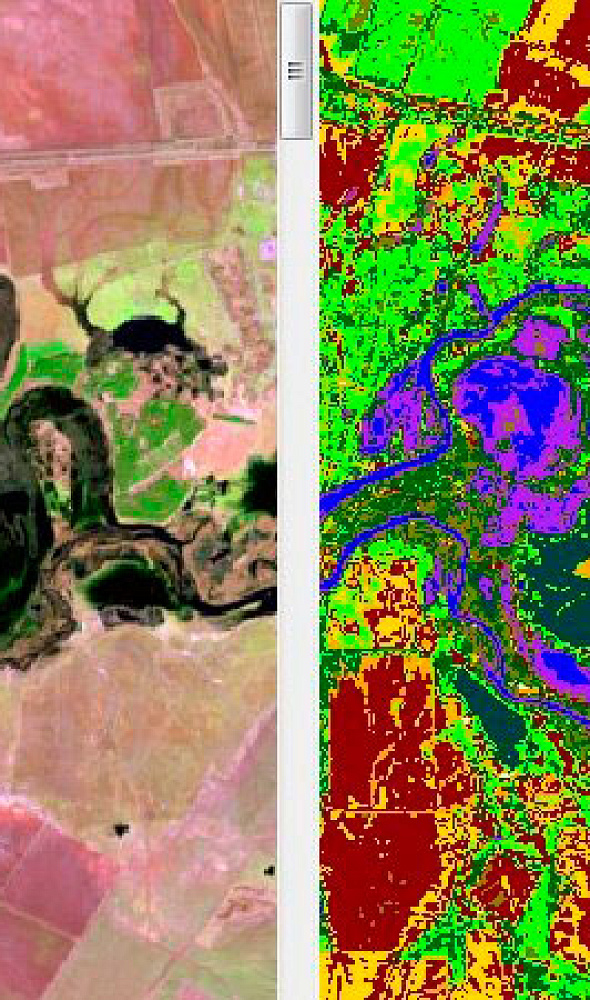
A GIS layer of contaminated land plots with pollution types and degree in the attribute table.
The layer is formed from image interpretation, field inspection, laboratory studies and analysis of the customer’s data.
What you get
- a layer of contaminated land plots
- pollution types and degree in the attributes
- a basis for a register of contaminated and disturbed land
The set of layers and attributes is agreed in the terms of reference.
02
Water bodies
A GIS layer of water bodies contaminated with oil, with pollution types in the attribute table.
Inventory of water bodies is part of the work along with land plots.
What you get
- a layer of water bodies contaminated with oil
- pollution types in the attributes
- materials for a register of contaminated water bodies
Layer composition depends on the area of interest and the terms of reference.
03
Waste and samples
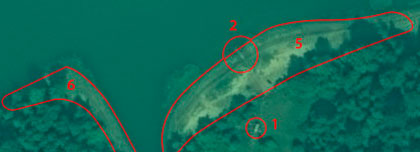
A layer of temporary waste-storage sites and a layer of soil, ground and bottom-sediment sampling points.
Waste attributes indicate types and status: reclaimed or not reclaimed. Sample attributes indicate sample type.
What you get
- temporary waste-storage sites with reclamation status
- sampling points (soil, ground, bottom sediments)
- if agreed — inspection reports, sampling schemes and chemical-analysis protocols
Field work and laboratory studies are performed in the scope agreed in the contract.
04
Report and register
A final analytical report with statistical, analytical and technical information and a general register of contaminated land or water bodies.
The report and documents per the contract list are sent to the customer electronically in agreed formats according to the terms of reference.
What you get
- a final analytical report
- a register of contaminated and disturbed land or water bodies
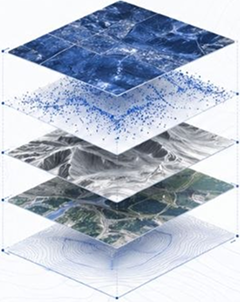
- cartographic and attribute GIS layers of classified data
Formats and the list of documents are fixed in the contract and the terms of reference.
How the work goes
Cost and timeline
The cost depends on the number of processed images and the work area and is calculated individually for each customer.
- consultation — free of charge
- image selection and preliminary analysis — free of charge
- ordering radar and optical images: the cost of RS materials is calculated individually; free satellite images and/or commercial satellite images may be used
- the cost of mapping natural and anthropogenic objects from image interpretation, field inspection and laboratory studies is calculated individually
- work — from 300 000 RUB; in the cost field — 300 000 RUB
- timeline in the card field — from 5 days; in the timeline block, in the FAQ and in the order steps — from 20 working days from the date the advance payment is received
- the timeline depends on the total area of interest, availability of archival RS materials or a new survey, requirements for RS materials and the end product, and work complexity
- in the order steps: 100% advance payment for satellite survey materials, the remaining payment after the work is completed; payment by bank transfer only; images are paid separately
Total cost — from 300 000 ₽
Timeline — from 20 working days
Consultation and preliminary analysis — free of charge
What data are needed for a quote
To assess feasibility, cost and timelines, please provide:
- location of the object of interest (coordinates, district/region name, shapefile)
- questions to be solved
- analysis / monitoring time period
- requirements for satellite and airborne survey materials: ground resolution, survey type, survey period
- whether monitoring has previously been carried out in this area
- your own survey materials or consent to select archival, free or commercial radar and optical images
If the specified information cannot be provided, describe the intended use of the RS materials — specialists will analyse the requirements and propose an option.
Describe the site, questions and period — we will assess the archive and the scope of work.
Why Innoter
Prompt access to archives
Suitable archive imagery can be obtained faster when the required area and date are already available from operators.
No aviation clearances
A new satellite survey does not require the flight clearances typical of aerial surveys.
Large and remote areas
A single satellite pass covers large areas and makes it possible to work in hard-to-reach regions.
Direct agreements with operators
Distribution agreements help select archive imagery and order new surveys from different providers.
Software and server infrastructure
Modern software and computing capacity for quality control and processing of large data volumes.
Experienced specialist team
Years of experience on complex projects and specialists in cartography, photogrammetry and remote sensing.
RS methods, sensors and source data
The composition depends on the area, archive or new survey, GIS requirements and field inspection.
1
Oil spills contaminate the land surface at the stages of oil production, transport and processing. Consequences are visible at once, but toxic effects onshore may appear years later, including through groundwater.
The main monitoring goal is to identify contaminated areas and establish the causes of their occurrence. The work is needed by oil-producing companies and bodies of the Ministry of Natural Resources of Russia to maintain the environmental situation and prevent nature-use violations.
The source cites industry figures: in 2019, fuel-and-energy enterprises of the Russian Federation had more than 17 thousand accidents with oil spills, of which 10.5 thousand were on oil pipelines. This is not an INNOTER price list.
2
Monitoring addresses the following tasks: detection of oil spills within licence blocks; localisation of contaminated land plots; assessment of reclamation rates; control of reclamation regulations; assessment of environmental consequences; integrated assessment of natural and man-made conditions; detection of emergency spills; information support for prevention and clean-up of emergency spills; study and analysis of environmental consequences.
Inventory of land and water bodies additionally includes confirmation that reclamation measures have been completed successfully. Environmental inventory and land certification are performed in accordance with federal environmental protection legislation, including to identify unregistered waste-disposal facilities.
3
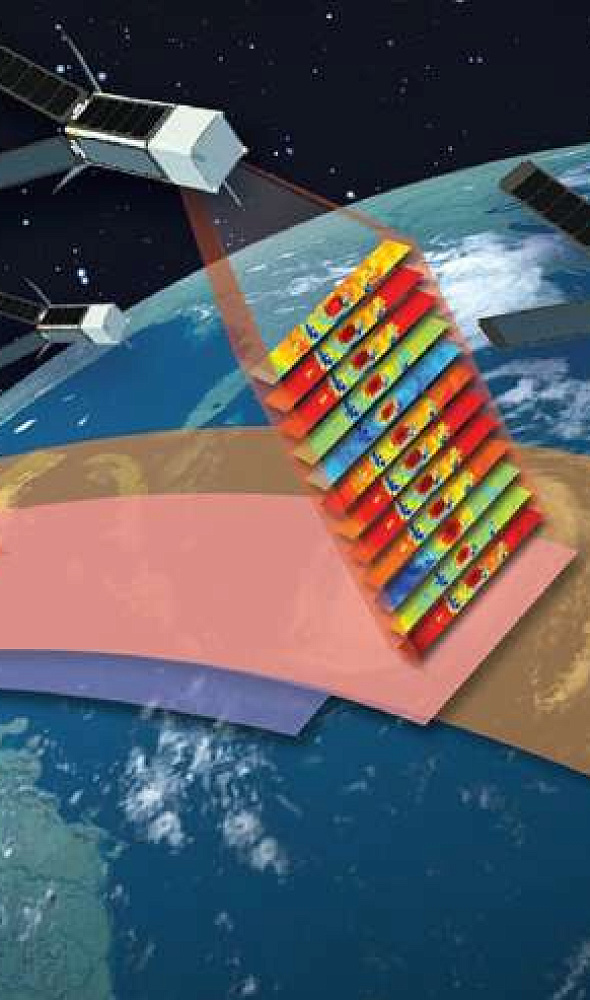
RS assets provide optical, multispectral and radar images of very high resolution: promptly localise and assess the scale of impact, including oil spills; assess the effect on ecosystems; reduce field work in hard-to-reach regions with harsh climate, wetlands and weak infrastructure; shorten timelines thanks to coverage.
At the local level, UAVs: observation of hazardous oil-infrastructure facilities; high-quality survey, including a video stream; periodic monitoring of pipelines up to a hundred km; prompt spill detection; assessment of pipeline technical condition, detection of damage, corrosion and ruptures; coordination of ground teams in emergencies.
4
Satellite monitoring highlights the contaminated area thanks to spectral bands. The infrared range in daytime uses oil heating: oil absorbs light and releases thermal energy at a temperature 3–8 K above the surroundings.
A laser fluorosensor identifies oil against water, soil, weeds, ice and snow and distinguishes oil types. Radar detects oil on water if the oil damps capillary waves under light or moderate sea/wind; radar enables search over large areas day and night and in bad weather. Satellite radar sensors are useful for mapping large spills but are limited by revisit frequency and lower spatial resolution.
5
An order requires exact coordinates of the area of interest and requirements for satellite and airborne survey materials: ground resolution, survey type, survey period. If there is no such information, the intended use of the RS materials is sufficient.
Before the contract: determination of survey dates and parameters; check of materials for the area of interest; check of compliance with the customer’s requirements. Result — feasibility of providing the service (yes/no).
Execution includes a very-high-resolution multispectral survey within licence-block boundaries and the inter-field territory; incoming quality control; photogrammetric processing with a DEM, fused images, orthorectification and orthomosaics; field sampling and chemical-analytical control; mapping of natural and anthropogenic objects; primary processing of radar images; an analytical report and a register of contaminated land.
6
Oil-pollution monitoring is performed in accordance with federal environmental protection legislation.
The source cites: Decree of the Government of the Russian Federation No. 2451 of 31.12.2020 on rules for organising measures to prevent and liquidate oil and oil-product spills on the territory of the Russian Federation (except internal sea waters and the territorial sea); Federal Law No. 207-FZ of 13.07.2020; the duty to develop an oil and oil-product spill prevention and liquidation plan (OSPLP) in production, manufacture, transport, storage and sale of hydrocarbon feedstock (clause 4 of the new wording of Article 46 of Law No. 7-FZ); Order of the Ministry of Natural Resources of the Russian Federation No. 696 of 20.12.2017 — Oil Spill Detection Methodology.
The source wording about 100% quality of services was not carried into the materials as a numerical guarantee.

Frequently asked questions
Answers to key questions about service parameters, timelines, deliverable formats and workflow. If you did not find what you need — contact us and we will help.
To assess the state of an oil spill, the following set of data is required:
- Possible location of the oil spill, environmental information (coordinates, district name, region, SHP file, etc.);
- Requirements for the time period (period for which archival data can be used or the need for new imagery);
- Whether monitoring has been conducted in this area previously.
The terms of monitoring works execution depend on the area, requirements to the survey parameters. The minimum execution time is from 20 working days.
100% prepayment on the invoice for RS materials after signing the contract, the rest of the payment after execution.
- Identifying violations of environmental protection requirements established by the legislation of the Russian Federation;
- Establishing the reasons that caused environmental pollution;
- Determining the damage caused as a result of environmental pollution.
In order to develop the observation system for detection of oil (oil product) spills in the Arctic zone of the Russian Federation characterized by extreme natural and climatic conditions and low population density, it is advisable to preferentially use methods of remote sensing of the Earth's surface (aerial and space imagery methods).
- Appeals and statements from citizens, including individual entrepreneurs, legal entities, information from government authorities, local self-government bodies, and mass media about incidents posing a threat to the life, health of citizens, harm to animals, plants, and the environment, as well as incidents causing harm to life, health of citizens, harm to animals, plants, and the environment;
- Information about natural and man-made emergencies and disasters;
- Results of public control in the field of environmental protection (public environmental control);
- Data from Earth remote sensing;
- Other information in accordance with the legislation of the Russian Federation.
The monitoring organization consists of three stages and includes:
- Preparatory work (developing a preliminary system for organizing monitoring in the region, methods of conducting it);
- Preliminary survey of the spill area (ground-based methods may be used);
- Planning the organization of the monitoring system.

Need satellite imagery or help choosing the right data?
Describe your task, area of interest, and desired outcome. We will check data
availability, assess new acquisition options, and propose the optimal solution in terms of timelines, cost,
and quality.
Discuss the project
clients who trust us
25+ years in the geodata market